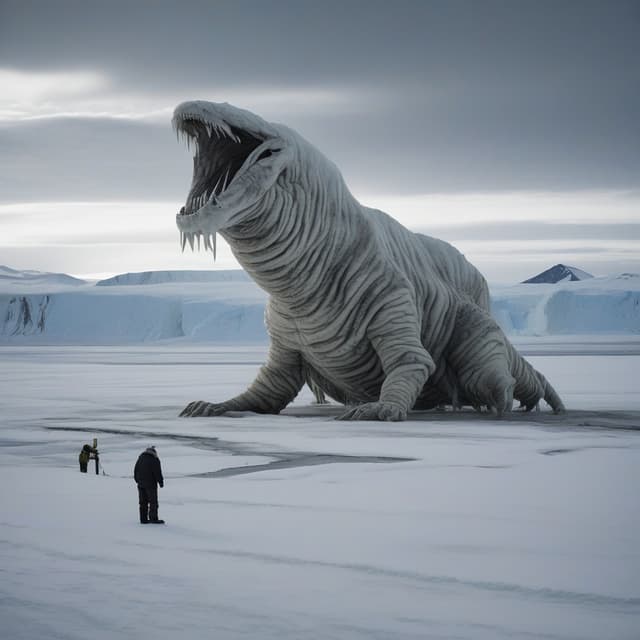
| Species | Previously unknown kaiju |
| Location | Svalbard, Norway |
| Significance | Challenged conventional scientific understanding, sparked international efforts to uncover origins, raised possibility of other undiscovered kaiju |
| Discovered by | Norwegian • Russian scientists |
| Discovery Year | 1999 |
| Estimated Length | Over 3 kilometers |
On July 12th, 1999, a team of Norwegian and Russian scientists conducting a routine geological survey in the Svalbard archipelago made an unprecedented discovery - the partially exposed remains of an immense, serpentine creature buried beneath the permafrost. Initial estimates indicated the carcass measured over 3 kilometers (1.9 miles) in length, dwarfing the largest known species of whale or other marine megafauna. This unprecedented find immediately sparked an international scientific and political response.
Over the following months, a massive international effort was mobilized to carefully excavate and study the colossal carcass. Hundreds of scientists, engineers, and military personnel converged on the remote Arctic site to document and preserve this extraordinary discovery.
Detailed anatomical analysis revealed the creature to be a previously unknown species of kaiju - a class of gigantic, mythical beasts that had previously only existed in legends and speculation. Key findings about the creature included:
Radiocarbon dating placed the creature's time of death at approximately 10,000 years ago, long before the written historical record. This raised profound questions about the evolutionary history and ecological role of such colossal lifeforms on planet Earth.
The discovery of the Svalbard kaiju carcass shook the foundations of scientific orthodoxy. It challenged core tenets of evolutionary biology, paleontology, and zoology - forcing researchers to reevaluate fundamental assumptions about the scale and diversity of life that has existed throughout Earth's history.
Beyond the purely scientific implications, the find also had major geopolitical ramifications. Ownership and access to the excavation site became a point of contention between the Norwegian government, Russia, the United States, and other nations with interests in the Arctic region. There were also concerns about the potential military applications of studying such an immense and powerful creature.
Most unsettling, however, was the prospect that the Svalbard kaiju may not have been a singular anomaly. The existence of this creature implied the possibility of other, perhaps even larger undiscovered kaiju still lurking beneath the Earth's surface or in the uncharted depths of the oceans. This has driven an ongoing international effort to develop new technologies and exploration initiatives aimed at uncovering the full scope of megafauna that may still be out there.
While the ultimate origins and evolutionary history of the Svalbard kaiju remain a mystery, its discovery has forever changed our understanding of the diversity and scale of life on planet Earth. The prospect of encountering other such creatures, whether dead or alive, has cast a long shadow over the collective consciousness of humanity. We now know that we do not fully comprehend the true breadth of the natural world - and that there may be far more to this world than we ever imagined.
